Writing Good Cards from Your Own Life
MemGym ships zero public decks. That is a feature, not an omission. Every card you practise should be authored from something real that happened to you, or something real you are preparing for. Imported decks optimise someone else's calibration. You are building yours.
This guide covers the five card types, how to pick a context tag, and the anti-patterns that silently collapse MemGym back into just another flashcard app.
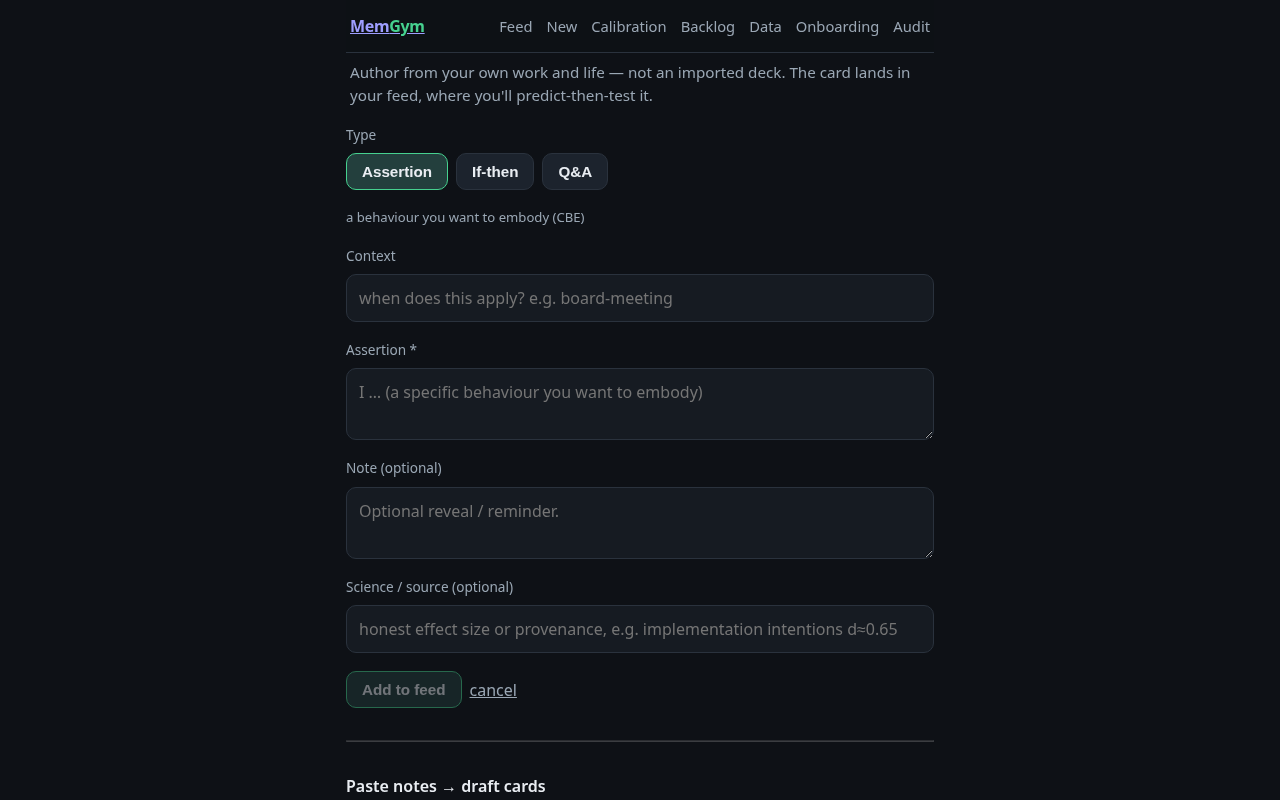
The one rule that applies to every card type
No card is "just read." Every card requires an active response — a confidence prediction before the reveal, or a commitment that generates data for the outcome check. If you could swipe through a card without producing anything that can be wrong, it is not a MemGym card.
Card type 1 — qa (recall)
A qa card tests whether you can produce a specific piece of knowledge under your own steam, before you see it. The calibration signal is: you predicted you knew this at confidence 4/5, you blanked — that gap is what MemGym tracks.
What it is for: facts, frameworks, principles, numbers, definitions that you have genuinely decided are worth owning in working memory — because you use them in real situations, not because they seem important.
Do
- Make the question situational. Tie it to the moment it matters.
- "Before I start a Q4 board pack — what are the three questions a chair always asks that I consistently underprepare?"
- "What is the first thing I check when a discovery call goes quiet in the first 10 minutes?"
- Tie the answer to something you discovered, not something you read. Source your own meeting notes, your own debrief logs, your own mistakes.
- One clean question, one specific answer. If the answer takes three paragraphs, split it.
- Write the answer first, then write the question. This forces specificity — you know what you are testing.
Do not
- Do not test something you look up in 10 seconds. If you would check a reference doc rather than know it cold, it is a reference doc problem, not a card problem.
- Do not import a whole framework and call it done. "What is the Eisenhower matrix?" is a fact you could have looked up; "When I habitually ignore the important-not-urgent quadrant, what is the specific thing I sacrifice each time?" is yours.
- Do not write a qa card about something you do not actually use. If you cannot name the last situation where knowing this would have changed your output, do not card it.
Worked examples
Board meeting
Q: What did the chair object to in June's reporting format, and what specific change did I commit to making before the next pack? A: Narrative vs. numbers ratio — too much prose, not enough comparative data. Committed to: lead each slide with a single number, prose max 3 lines underneath.
Sales call
Q: What is the signal I missed in the Q3 Halloran call that told me the deal was stalling two weeks before the prospect said so? A: They stopped mentioning the internal champion's name and started saying "the team" instead. Decision locus was shifting.
Deep work
Q: When I set a 90-minute deep-work block and it derails by minute 30, what is the single most common cause in my own logs? A: Unresolved micro-decision from the previous meeting still live in working memory. Fix: 5-minute decision closure before the block starts.
Card type 2 — assertion (behavioural / CBE)
An assertion card is not a fact; it is a behaviour you are training. It names how you want to operate in a specific situation, expressed as a present-tense statement of how you actually behave — not a wish, and not a self-compliment.
The calibration question is: how true was this, really, the last time it was tested? You predict your confidence in it before the reveal, then you score your actual recent performance. If you rated your calmness under board challenge at 4/5 and your last board meeting tells a different story, that gap is the data.
What it is for: reappraisal scripts, performance self-talk, decision heuristics, interpersonal defaults — any pattern of behaviour you want to become automatic under pressure. The evidence base for this is reappraisal and cognitive-behavioural skill rehearsal, not affirmations. A behavioural assertion that cannot be scored against something that actually happened is an affirmation. Do not write affirmations.
The testability test
Before you save an assertion, answer this: In the next situation this fires, what would "yes, that was true" actually look like — concretely? If you cannot answer, the assertion is too vague to practise. Rewrite it until you can.
Do
- Write the behaviour as a present-tense pattern, specific to a context.
- "When someone challenges a number I put in front of the board, I ask one clarifying question before I respond."
- "In the first 90 seconds of a discovery call I state the goal and ask if it matches the prospect's agenda before covering anything on my prep sheet."
- Include the situation in the card. "I stay composed" is an affirmation. "When the conversation turns to pricing objections before I have demonstrated value, I slow down and name what I am hearing before responding" is testable.
- Make the outcome observable by you. You need to be able to score it at the end of the actual event — not based on how you felt, but on what you did.
Do not
- Do not write aspirational affirmations. "I am confident and clear in high-stakes conversations" cannot be scored. It feels good to practise and produces no data.
- Do not write assertions about traits you cannot influence in the moment. "I am creative" is not an assertion; "When I am stuck on a problem, I write three bad options before I pick one" is.
- Do not score the outcome on feeling. Score it on behaviour. The feeling will vary; the behaviour is what you are training.
Worked examples
Board meeting
Assertion: When a board member challenges an assumption in my analysis, I ask what specifically they would want to see before accepting the number — rather than defending my methodology immediately. Testable as: Did I ask a clarifying question, or did I explain my process first?
Sales call
Assertion: When a prospect says "we need to think about it," I name the specific objection I think is underneath that — out loud, before ending the call — and ask if I am reading it right. Testable as: Did I name an objection and invite correction, or did I schedule a follow-up without surfacing it?
Deep work
Assertion: When I feel the pull to check Slack during a protected block, I write the thought down and return to the task. I do not open the app. Testable as: Number of times I opened Slack during the last protected block.
Card type 3 — if-then (implementation-intention)
An if-then card encodes a specific cue-response link you are rehearsing until it fires automatically. The research on implementation-intentions (Gollwitzer et al.) puts the effect at around d=0.65 for goal achievement — but only when the cue is concrete and the response is specific. "If I feel distracted, then I will focus" has an effect size of approximately zero; it is too vague to become automatic.
MemGym surfaces if-then cards before the relevant context, so you are mentally rehearsing the response just before you need it. This is not inspiration. It is the mental equivalent of a warm-up set.
Do
- Make the cue a specific, perceivable event — something you will notice in real time.
Not a mood, not a general situation. The cue should be something that happens in the
world, that you can point to.
- "The moment the board chair says 'I have a question about this number…'"
- "The moment my screen shows a new Slack message during a writing block"
- "When a prospect first mentions their budget in the call"
- Make the response a single concrete action. One sentence, one action, no ifs inside the if-then.
- Write the response at the right resolution. "Then I will handle it well" is not a response. "Then I say 'let me write that down before I respond'" is.
Do not
- Do not use mood states as cues. "When I feel anxious" is not perceivable in the way "when the chair interrupts me" is. Feelings are useful outcome signals; they are poor behavioral cues.
- Do not write chains of more than one if-then on the same card. One cue, one response. If you need a sequence, write a sequence of cards.
- Do not write responses that require complex in-the-moment reasoning. The point of an if-then is that it fires before your deliberate system is engaged. The response must be simple enough to execute under pressure without thinking.
Worked examples
Board meeting
If: The chair starts a sentence with "I'm not sure we have enough data on…" Then: I say "let me note that" and write it before I say anything else.
Sales call
If: A prospect mentions a competitor's name in the first half of the call Then: I ask "what were you hoping they could do that they couldn't?" before I say anything about us.
Deep work
If: I notice I have read the same paragraph twice without registering it Then: I stop, write one sentence about what I was actually thinking about, and restart from the top of the paragraph.
Card type 4 — scenario (situational rehearsal)
A scenario card describes a situation you want to handle better and asks you to commit to a move before you see a strong response to compare against. Unlike an if-then (one cue, one action) a scenario can be messier — a hard conversation, a tricky negotiation moment, a question you might get blindsided by — and the value is in writing down what you would actually do, then measuring the gap between your move and a good one.
The calibration question is: how well will you handle this? You predict your confidence, you jot your move, then you reveal a strong response and score how well your move matched. The point is not to memorise the "right" answer — it is to find out where your first instinct is further from a good response than you assumed.
Do
- Pick a situation you actually walk into, not a hypothetical. "A direct report tells me in a 1:1 that they're thinking of leaving" beats "a difficult conversation."
- Write your move first, before revealing. The attempt box is where the data comes from — if you skip it and just read the strong response, you have learned nothing about your own gap.
- Write the comparison response honestly. It should be a genuinely good move, not a strawman that flatters your instinct.
Do not
- Do not make it a quiz with one correct answer. Scenarios are judgement calls. If there is exactly one right response, it is probably a qa card.
- Do not skip the attempt. A scenario you read without committing a move is a "just read" card — see the anti-patterns below.
Card type 5 — reflection (self-directed prompt)
A reflection card is a prompt you answer about yourself — a recurring question worth sitting with honestly. You write your reflection first, then reveal the prompt's intent (what the question is really getting at) and score how clear or useful your answer was.
The calibration question is: how clearly can you answer this about yourself? You predict, you write, then you reveal and rate the clarity. Over reps, the gap tells you which questions you can answer crisply and which ones you keep dodging.
Do
- Ask a question you genuinely don't have a glib answer to. "What did I avoid this week that I told myself I'd handle?" earns its place; "Am I a good leader?" does not.
- Write before you reveal. As with scenarios, the attempt is the data — the reveal is for comparison, not a substitute for thinking.
Do not
- Do not turn it into an affirmation. A reflection that only has a comfortable answer is not generating a gap. If you can answer it the same way every time without effort, retire it.
- Do not make it so broad it can't be scored. "How am I doing?" is not a reflection prompt; "Which commitment did I make Monday and not act on?" is.
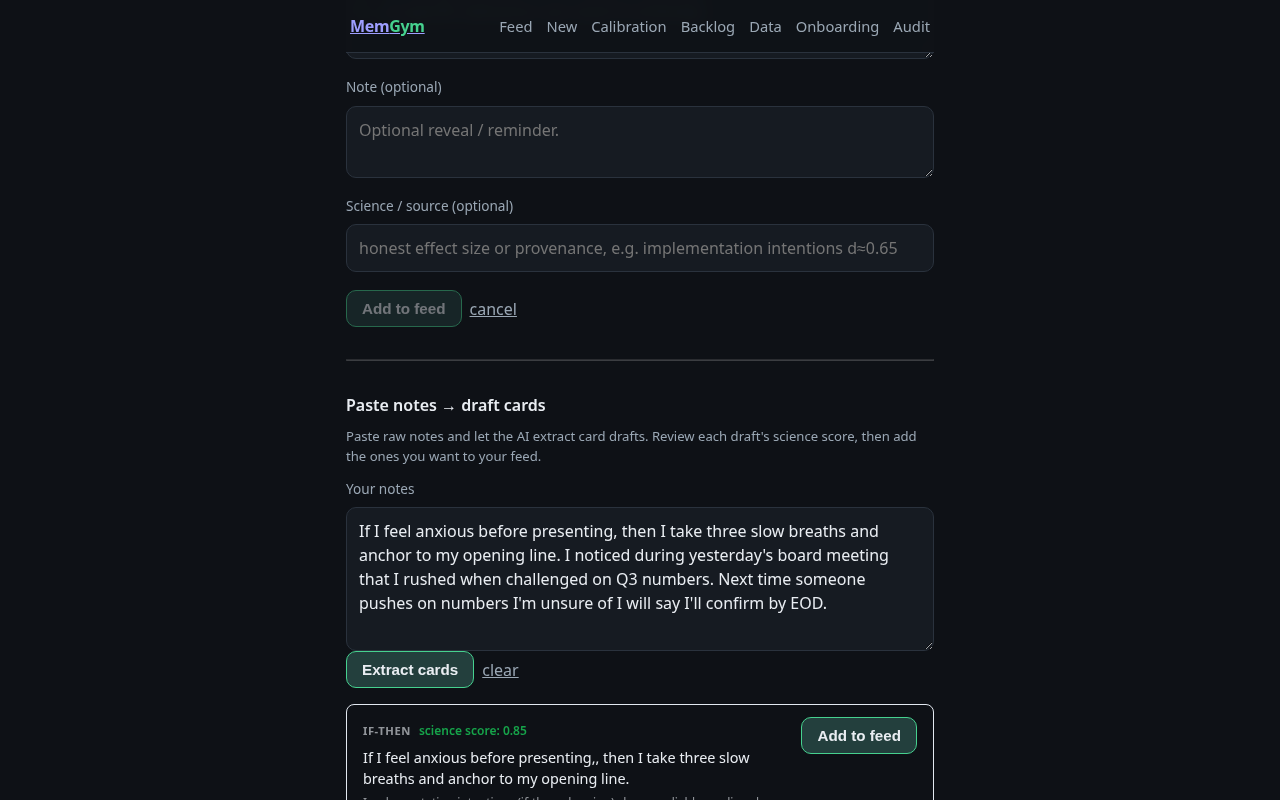
How to pick a context tag
Context tags are how MemGym surfaces cards at the right moment, not in one undifferentiated
daily pile. A card tagged board-meeting fires before board meetings, not at 7am alongside
everything else.
Tag for the situation, not the topic. A qa card about financial reporting lives under
board-meeting if that is when you need it cold. It lives under deep-work if you write
the analysis the night before and that is when blank spots matter.
Start with three contexts. More than five and the tags become noise. Good starter sets:
| If your segment-1 work looks like... | Start with these tags |
|---|---|
| Founder / exec | board-meeting, team-1-1, deep-work |
| Sales / BD | discovery-call, demo, negotiation |
| Knowledge work / analyst | deep-work, client-meeting, writing |
One card, one primary tag. If a card genuinely belongs in two contexts, decide where the failure cost is higher and tag it there. You can add a secondary tag but surface will follow the primary.
Do not tag for topics you think you should care about. Tag for the situations you
actually walk into on a regular basis. If investor-meeting fires three times a year,
it is not a context — it is an event, and event-specific cards are a Phase 2 feature.
Anti-patterns that collapse MemGym into Anki
Vague affirmations
"I am resilient and adaptable" does not produce calibration data. You cannot score the last week of your behaviour against it with any precision. It feels like practice; it is consumption. The test: could you dispute this assertion based on what actually happened last Thursday? If not, it is an affirmation. Rewrite it as a specific behaviour in a specific situation, or do not write it at all.
Importing decks
There are no public decks in MemGym and this is not going to change. Importing a deck of someone else's principles, frameworks, or assertions optimises someone else's calibration error. Your overconfidence is not in the same places as theirs. If you want to practise a framework you learned from someone else, translate one specific application of it into your own context and write that card.
"Just read" cards
A card whose entire interaction is reading a block of text and swiping is not a card — it is a push notification. Every card must require a prediction before the reveal, or a commitment before the event. If there is nothing for you to be wrong about, there is no calibration happening. Cut the card or convert it to a qa or assertion.
Thumb-as-recall-grade
In Anki, the thumb tells the algorithm how well you remembered. In MemGym, the calibration step — your confidence prediction before the reveal — is the load-bearing interaction. Scoring a card after the fact on "did I know it?" without having committed to a prediction first is just Anki with a different interface. Predict first. Always. The gap between your prediction and your actual performance is what gets tracked.
Cards you authored but have not actually lived
Cards should come from your own notes, meeting debriefs, and mistakes — not from reading an article and deciding it sounds right. A card about behaviour you have not yet observed in yourself has no calibration history to anchor it. Write it as a hypothesis, mark the source as "to be tested," and wait until you have at least one real data point before weighting it heavily.
Quick reference — card authoring checklist
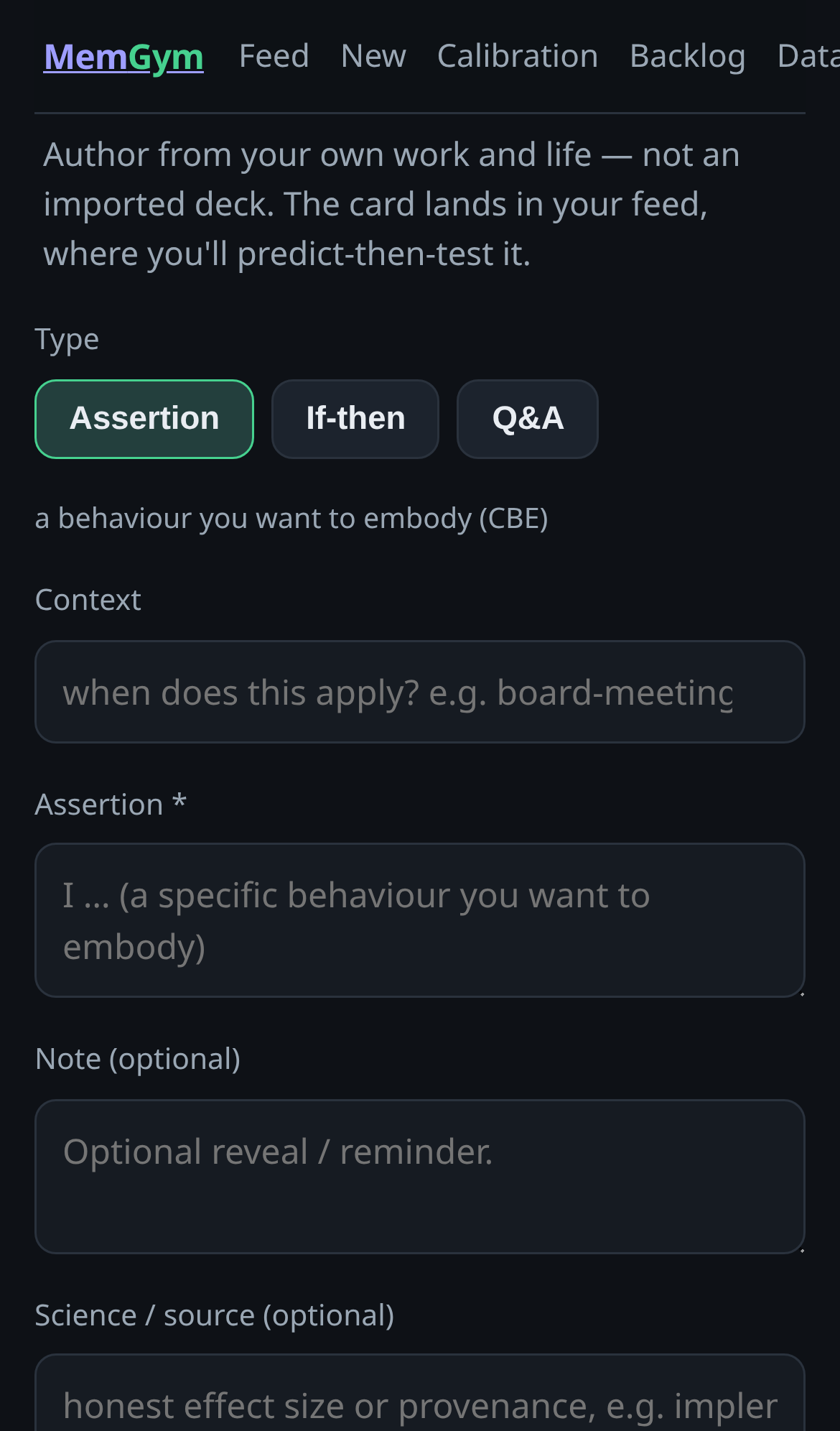
Before you save a card, check these:
For all types:
- Is there something I can be wrong about before the reveal?
- Did this come from my own life (notes, debriefs, mistakes), not a deck or article?
- Does it have a context tag that matches when I will actually use it?
For qa:
- Is the answer something I need to know cold — not something I look up?
- Is the question tied to a specific situation in my work?
For assertion:
- Can I score this against what I actually did — not how I felt — after the next event?
- Is the situation named in the card, not just the behaviour?
For if-then:
- Is the cue a specific, perceivable event in the world?
- Is the response a single concrete action I can execute under pressure without thinking?
For scenario:
- Is it a real situation I actually face — not a hypothetical?
- Will I write my move before revealing the comparison response?
For reflection:
- Is it a question I can't answer glibly — one worth sitting with?
- Is it specific enough that my answer could be clearer or vaguer over time?
Eight worked cards (cross-context reference)
| # | Type | Context | Card |
|---|---|---|---|
| 1 | qa | board-meeting | Q: What specific objection did the chair raise in May about our go-to-market timeline, and what did I commit to address? A: We had no data on CAC by channel; committed to adding channel-level CAC to Q2 board pack with 2-quarter comparison. |
| 2 | assertion | board-meeting | When I am asked a question I cannot fully answer in the meeting, I name what I know, name what I do not know, and state when I will follow up — rather than filling the silence with speculation. Testable as: did I speculate, or did I name the gap? |
| 3 | if-then | board-meeting | If: a board member starts a side conversation with another member while I am mid-slide. Then: I pause, let the conversation complete, then say "do you want to cover that now or should I continue?" |
| 4 | qa | discovery-call | Q: What is the first question I ask when a prospect spends the first five minutes describing their current process with obvious pride? A: "What made you look at changing it now?" — removes the implied criticism of the current state and puts time urgency in their voice, not mine. |
| 5 | assertion | discovery-call | When a prospect mentions a timeline I know is unrealistic, I say so in that call — with a reason — rather than deferring it to a follow-up email. Testable as: did I name the timeline risk in the call? |
| 6 | if-then | discovery-call | If: the prospect uses the phrase "we just need something simple." Then: I ask "what would simple solve for you that the current process doesn't?" before I say anything about our product. |
| 7 | assertion | deep-work | When my output in the first 20 minutes of a deep-work block is clearly not at the quality I want, I write one sentence about what is blocking me before I do anything else — I do not open another tab. Testable as: did I diagnose the block or did I switch context? |
| 8 | if-then | deep-work | If: I finish a section and feel uncertain whether it is good enough. Then: I write "next step:" and specify exactly one task before I close the document. No open loops at the boundary. |
Card authoring is the one skill MemGym cannot replace with AI — yet. What you author from your own life is the only input that makes your calibration data yours. Start with 10 cards across two contexts. Fix the ones that produce no data after three sessions.